At Garderie Saint-Bruno, our pedagogical approach is built on a thoughtful hybrid of the four-quarters program and Montessori education. We believe that no single method can meet every child's needs: that is why we have chosen to combine the structure and balance of the four-quarters program with the guided freedom, autonomy, and sensory materials at the heart of Montessori. The result is an environment where children benefit from clear frameworks as well as space to explore at their own pace, in line with their overall development.
The foundations of the four-quarters program
The four-quarters program, as we use it, rests on the idea of balance among four essential dimensions of the child's development: cognitive, affective, social, and physical. Each "quarter" represents a pillar of our planning: we ensure that no dimension is neglected in favour of another. Activities are designed to nurture intellectual curiosity (language, early math, discovery of the world), emotional security and the expression of feelings, social skills and cooperation, and gross and fine motor development. This balanced distribution helps children grow in a harmonious way and sets the stage for a calm, confident transition to school.
In practice, the four-quarters program translates into schedules and routines that alternate between more guided moments and free play, between group activities and small-group or individual time. Educators plan with intention, drawing on Quebec's early childhood program objectives while staying attuned to the children's interests. We document progress and observations to ensure each child is advancing in all four dimensions, and we adjust our offerings based on what we see day to day.
The contribution of Montessori pedagogy
Montessori pedagogy inspires us through its deep respect for the child's rhythm and the importance it places on the prepared environment and concrete materials. In our setting, the environment is arranged so that children can access materials suited to their size and stage of development: low shelves, work trays, practical life and sensorial discrimination activities. Children are invited to choose activities, use them repeatedly, and put them away after use, which supports autonomy, concentration, and a sense of responsibility. We never force a child to do an activity; we invite them, present the material clearly, and leave room for experimentation and error as natural parts of learning.
The Montessori materials we integrate — for example dressing frames, botany or geography puzzles, bead material for counting, sandpaper letters — provide sensory, hands-on experiences that strengthen understanding. Children learn by touching, comparing, ordering, and repeating, which matches their need for concrete experience before abstraction. At the same time, we are not strictly "Montessori": we adapt the materials and presentations to our Quebec daycare context and to our hybrid approach with the four-quarters program. The goal is not to apply a method dogmatically, but to draw on it to offer a rich, orderly environment that respects each child's development.
Creativity, arts, and expression
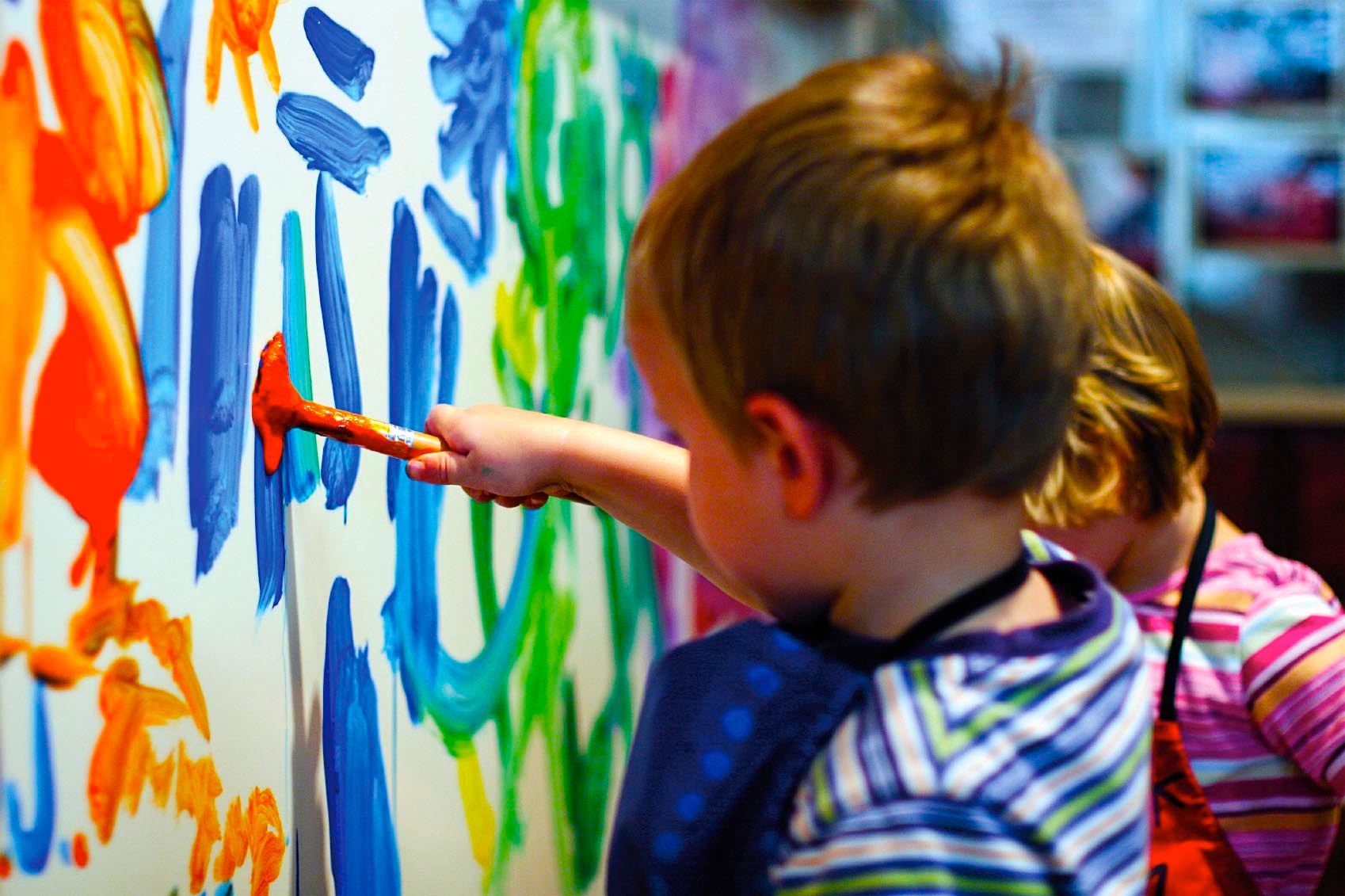
Creativity and the arts hold a central place in our pedagogical hybrid. Whether through painting, drawing, collage, music, or movement, we give children many opportunities to express themselves and explore their ideas. These activities reflect both the four-quarters program (affective and creative development) and the Montessori spirit (choice, manipulation, concentration). Children are encouraged to create without judgment: there is no "right" or "wrong" result, only a process in which the child experiments, discovers, and enjoys making. We present materials in an accessible way and invite children to use them independently, while sometimes suggesting themes or techniques to enrich their work.
Group creative moments also support language, sharing of ideas, and cooperation. Children describe their work, explain what they did, and listen to others. We document these moments with photos and notes for families and to help us track the evolution of interests and skills. By integrating the arts into daily life, we aim for children who feel capable of expressing themselves, who dare to try, and who associate learning with joy and discovery.
The role of the educator: guide and observer
In our hybrid approach, the educator is neither a traditional teacher who directs the whole group at the same pace nor a mere supervisor. She is a guide and an observer. She prepares the environment, presents the material clearly and calmly, and observes the children to understand their needs, interests, and challenges. She steps in when a child needs support or a reminder of the rules, but she also leaves plenty of room for initiative and exploration. She knows that each child has a different rhythm and that the adult's role is to accompany without imposing, to encourage without over-stimulating, and to create a climate of trust where the child feels free to learn.
Our team's ongoing training is essential. We ensure that educators are comfortable with the principles of the four-quarters program and with the basics of Montessori pedagogy (presenting materials, managing the environment, observation). We regularly share our observations as a team and adjust our practices based on feedback from families and the needs of the children. This collaborative, reflective approach allows us to offer a coherent, caring pedagogical framework.
Routines, transitions, and group life
Routines and transitions structure the day and give children reassuring reference points. We draw on the four-quarters program to organize predictable sequences: welcome, circle time, workshop or free-choice activities, snack, outdoor play, lunch, rest or relaxation, and afternoon activities. Transitions are supported by songs, rhymes, or rituals that help children move from one moment to the next without stress. At the same time, we stay flexible: if a group is deeply engaged in an activity, we can extend the time; if a child needs more calm, we offer a space to recharge.
Group life is also a setting for social learning. Children learn to wait their turn, share materials, resolve conflicts with adult support, and care for the shared environment (tidying, cleaning, respecting rules). These skills are essential for their future school journey and for life in society. We work on them every day in a spirit of kindness and cooperation, using communication models that support non-violence and the acknowledgment of emotions.
Partnership with families
Our pedagogical approach only reaches its full meaning in partnership with families. We want parents to understand the foundations of the four-quarters program and our Montessori inspiration, and to feel themselves as partners in their child's education. We communicate regularly through informal exchanges, portfolios or journals, and scheduled meetings to review the child's development and interests. Families are invited to share their observations, questions, and expectations so that we can align our practices with the values of the home and the specific needs of each child.
In summary, our hybrid pedagogy — four-quarters program and Montessori — aims to provide a balanced, structuring, and caring framework where each child can develop their cognitive, affective, social, and physical skills while benefiting from a prepared environment, choice, and autonomy. We believe this combination prepares children to become curious, responsible, and confident learners, ready for school and for life.